CARBOTURA
01 / 16
CARBOTURA

TECHVIEWS

THE ACM MODULAR FACTORY MODULE, IN FOUR VIEWS
Released — Public
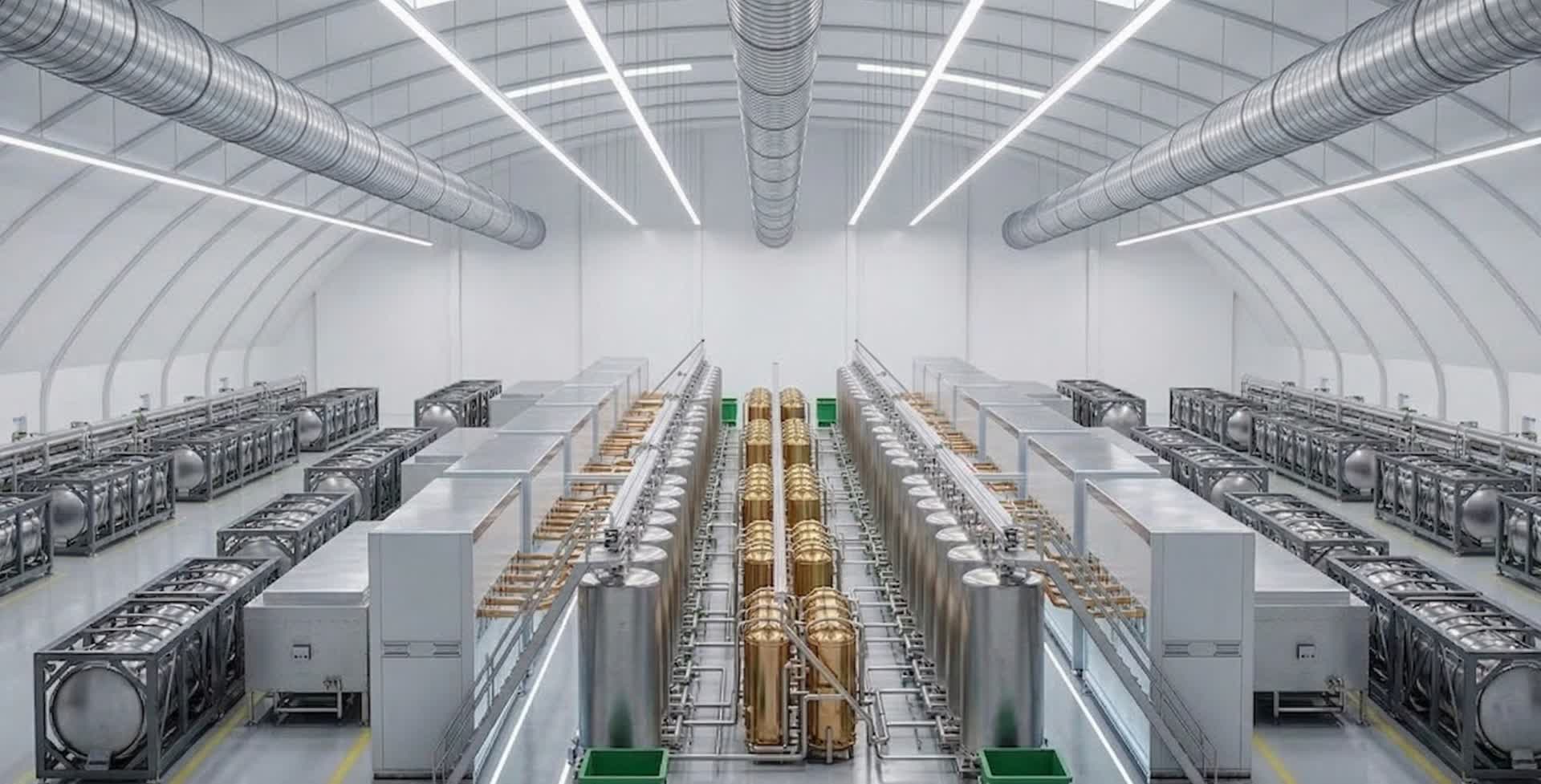
Interior of a Carbotura ACM Manufacturing Center: modular production units, process vessels and containerised material handling under a single clear-span roof.
TECHNICAL DISCUSSION RELEASED — PUBLIC  ·  NOT AN OFFER TO SELL SECURITIES  ·  REV 2026.09
CARBOTURA
02 / 16
TECHNICAL DISCUSSION · MODULAR FACTORY MODULES

One machine, four ways of asking whether it works

The same Advanced Circular Manufacturing (ACM) module has to satisfy four different rooms, and each asks a different question. Engineering asks what it does to the material. Operations asks how it runs. Manufacturing asks how it is reproduced. Investment asks what that architecture is worth. The answers are the same machine, described four ways. Engineering runs longest, because the category difference is where the technology is either understood or lost.

↓  CHOOSE A VIEW, OR PAGE THROUGH WITH THE ARROWS BELOW
DESIGN FOR MANUFACTURABILITY  ·  MODULES ARE MANUFACTURED PRODUCTS, NOT CONSTRUCTION PROJECTS
ACM MODULAR FACTORY RELEASED — PUBLIC  ·  NOT AN OFFER TO SELL SECURITIES  ·  REV 2026.09
CARBOTURA
03 / 16
01 · ENGINEERING

Elemental dissociation, not molecular conversion

Four protocols, in sequence. No polymer or input molecule survives the process: outputs are synthesized from elemental constituents rather than recovered as surviving fragments. That distinction is categorical, and most of what follows depends on it.

PROTOCOL 1
Pregenesis™
Feedstock preparation — shred, magnetic ferrous separation, Liquifact™ extraction.
PROTOCOL 2
Regenesis™
Primary elemental dissociation in the Recyclotron™, resolving feedstock into OmniCrude™ Vapor and Solids.
PROTOCOL 3
Regenesis MAX™
Separates and refines both OmniCrude™ streams into Circular Materials.
PROTOCOL 4
Exogenesis™
Urban and landfill mining of legacy buried deposits, conditioned for Protocols 1 to 3.
The vapor line, in order. The Recyclotron™ performs primary elemental dissociation, resolving feedstock into OmniCrude™ Vapor and Solids streams; vapors undergo secondary reforming and shift conversion before separation into finished materials. Secondary reforming is the CRSRU (Carbon Recovery Syngas Reforming Unit); shift conversion is Water Gas Shift. Both sit on the vapor stream only.
Contaminant destruction is structural, not probabilistic. PFAS and PFOS molecules cannot survive elemental dissociation, and no legacy-polymer contamination pathway exists into food-contact or medical grades.
No combustion anywhere in the line. No stack, no scrubber, no discharge. Near-zero residual and near-zero emissions are structural properties of the architecture rather than operating targets.
THE RECYCLOTRON™ IS A MODULE WITHIN REGENESIS™, NOT A FIFTH PROTOCOL
ENGINEERING · WHAT IT DOES RELEASED — PUBLIC  ·  NOT AN OFFER TO SELL SECURITIES  ·  REV 2026.09
CARBOTURA
04 / 16
01A · ENGINEERING DOCTRINE

Two claims hold everything else up

The doctrine is not a style guide. Two technical claims carry the regulatory and the commercial posture, and every other statement in this deck sits downstream of them. Drift in either is not a wording problem.

CLAIM ONE
The technology is established and integrated.
Almost every component is commercially available equipment with reference installations. What is new is the integration and the operating point, not a novel machine. That is why the envelope can be specified, measured and underwritten.
CLAIM TWO
The process is near-zero, no-combustion, closed-loop manufacturing.
No stack, no scrubber, no discharge. That is what places the facility under manufacturing classification, NAICS 31 to 33, rather than under waste management.
01
The elemental description rests on an evidence chain, not on assertion. Three hundred and fifty government material-characterization studies, weighted by characterized tonnage and reported margin of error. Roughly 89% of characterized mass falls inside one common design envelope, and roughly 99% of as-received mass resolves to sixteen elements: carbon, oxygen, hydrogen and nitrogen dominate, ten minors sit below them, and a few traces vary by region.
02
Throughput is named, not estimated. Each building runs to a named design throughput with installed N+1 line-capacity architecture on a P90 planning basis. Redundancy is designed in rather than left to oversizing.
03
Authorship and accountability are separate roles. Carbotura as OEM authors the module production specification and governs manufacturing. An Authorized Systems Integrator (ASI) is the single accountable party for factory acceptance, site acceptance, integration testing and warranty.
THE ARCHITECTURE IS ITSELF THE CLASSIFICATION ARGUMENT  ·  NO SOLID-WASTE FACILITY IS MANUFACTURED AS A PRODUCT AND REPLICATED FOR CAPACITY
ENGINEERING DOCTRINE RELEASED — PUBLIC  ·  NOT AN OFFER TO SELL SECURITIES  ·  REV 2026.09
CARBOTURA
05 / 16
01B · THE FOURTH QUADRANT

Everyone else defends the molecule. We go past it.

Two questions sort every conversion route ever built: what happens to the molecules, and what happens to the atoms. Start all four routes from the same unsorted feedstock and the answer is just where the mass ends up.

Conventional manufacturing and recyclingASSETNarrow product bandLIABILITYResidual, onward to landfill or incinerationLandfill and storageLIABILITYStranded underground, value abandoned with itIncineration, waste-to-energy, conventional gasificationLIABILITYFlue gasLIABILITYSlag and ash. Energy recovered, elements notCarbotura ACM — the fourth quadrantASSET~90% sold as Circular MaterialsASSET~10% internal, self-powering the plantLIABILITYNear-zero residual — band drawn at a visible minimum
ONE INPUT, FOUR FATES, AND WHETHER EACH LANDS AS AN ASSET OR A LIABILITY. WIDTHS FOR THE THREE INCUMBENT ROUTES ARE INDICATIVE; ONLY CARBOTURA’S SPLITS ARE STATED FIGURES.
The claim is not destruction. Destruction is a century old. The claim is destruction with exact elemental conservation as the selectivity mechanism — and that is the difference from molecular and chemical recycling, which spend their whole unit-operation budget keeping molecules intact. We point the other way: all the way down to elements, and then synthesize new molecules from them.
AN ATOM CARRIES NO HISTORY  ·  CONTAMINATION, MIXING AND DEGRADATION ARE PROPERTIES OF MOLECULES, NOT OF ATOMS
THE FOURTH QUADRANT RELEASED — PUBLIC  ·  NOT AN OFFER TO SELL SECURITIES  ·  REV 2026.09
CARBOTURA
06 / 16
01C · WHY THE BOX STAYED EMPTY

Two assumptions, and both were wrong

If the fourth box is so valuable, the fair question is why nobody stood in it. Two beliefs kept the chemical process industry out of it, and each of them is answerable.

WRONG ASSUMPTION ONE
“The value lives in the molecules, so you have to save them.”
An atom carries no history. A carbon atom from a diaper is identical to a carbon atom from a laptop. Take material to the elemental level and contamination, mixing and degradation stop existing as categories, because they were properties of the structure. Destroy the structure and the mess goes with it.
WRONG ASSUMPTION TWO
“Breaking every bond costs more than the material is worth.”
The feedstock arrives carrying its own chemical energy, roughly twenty times the electrical power the process applies. The applied microwave field, on the order of five to six percent of the feed’s own energy content, is the trigger; the material’s own energy sustains the cascade. The feed pays its own demolition bill.
What falls out of the chaos is order. Reactions are driven deliberately to the point of chaos, and elemental order falls out of it: atoms are conserved exactly, and the reaction network reassembles them into a predictable product set fixed by chemistry and the operating point rather than by the feedstock’s history.
Which is why the product set does not depend on what came in. Roughly 100% of input becomes manufactured output, across 116 Circular Materials in six families and five RevCon™ tiers, with near-zero residual by structure rather than by effort.
TO CARBOTURA’S KNOWLEDGE, OCCUPYING THIS QUADRANT IS A DEPARTURE FROM THE DESIGN PHILOSOPHY OF THE CONVENTIONAL CHEMICAL PROCESS INDUSTRY
WHY THE BOX STAYED EMPTY RELEASED — PUBLIC  ·  NOT AN OFFER TO SELL SECURITIES  ·  REV 2026.09
CARBOTURA
07 / 16
02 · OPERATIONS

Island-Mode, and a closed loop that stays closed

Roughly 100% of input becomes manufactured output. About 90% of it is sold; the remaining 10% powers the plant. Nothing is burned for energy, and nothing leaves as a discharge.

~100%
Of input converted to manufactured outputs, not to energy
~90% / ~10%
Sold externally / used internally to self-power the plant
116
Manufactured materials, six families across five RevCon™ tiers
N+1
Installed line-capacity architecture, on a P90 planning basis
01
Island-Mode means the plant carries its own load. Captive hydrogen powers PEM fuel cells internally. Carbotura does not sell power, electricity or hydrogen — energy is internal only, and never a revenue line.
02
The only internal stream that returns as a product is water. The facility is net water-positive, and that ultrapure water is sold or donated.
03
Throughput is named, not estimated. Each building runs to a named design throughput with installed N+1 line capacity, planned at P90. Redundancy is designed in rather than left to oversizing.
04
The operating envelope is definable, which is why it is insurable. The equipment is recipe controlled, so its envelope can be specified, measured and underwritten.
NOT WASTE-TO-ENERGY  ·  NO MATERIAL-VERSUS-ENERGY SPLIT, AND NO RECOVERY RATE
OPERATIONS · HOW IT RUNS RELEASED — PUBLIC  ·  NOT AN OFFER TO SELL SECURITIES  ·  REV 2026.09
CARBOTURA
08 / 16
02A · DIGITAL TRIPLET

Three nodes, one shared data lake

A model that mirrors a single asset stops at that asset. The Digital Triplet closes a loop across three of them, so what a deployed module measures changes how the next one is specified and manufactured.

NODE 1
Engineering
Writes the specification before anything is manufactured, using multiphysics simulation.
NODE 2
OEM Module Manufacturing
Builds to that specification, under Carbotura’s manufacturing authority.
NODE 3
Facility Operations
Runs the deployed module and measures what it actually does.
DESIGN → BUILD   ·   BUILD → OPERATE   ·   OPERATE → REFINE   ·   ONE SHARED DATA LAKE UNDER ALL THREE
01
CAFI is the mechanism: Continuous Adaptive Feedback Integration. Ingest, enrich, return. Operating data from deployed modules is ingested, enriched against the specification, and returned to the node that authors it.
02
This is what makes the 2.5% manufacturing tolerance a measurement. Deployed modules confirm the production specification within tolerance, and the confirmation flows back into it. The specification is the production record rather than a forecast of one.
THE SPECIFICATION IS WRITTEN FIRST AND VALIDATED IN PRACTICE  ·  IT IS NOT INFERRED FROM A RUNNING PLANT
OPERATIONS · DIGITAL TRIPLET RELEASED — PUBLIC  ·  NOT AN OFFER TO SELL SECURITIES  ·  REV 2026.09
CARBOTURA
09 / 16
02B · MASS BALANCE

There is nowhere for anything to leak to

Closure is not a target the plant tries to hit each shift. It follows from four rules the architecture satisfies by construction, and every ACM deployment satisfies all four.

IPRIME RULE · NO NEW TECHNOLOGY
Established Technology Only
Every technology established, commercial grade, previously at industrial scale. The novelty is integration and orchestration.
IIPRIME RULE · NO EMISSIONS
Near-Zero Emissions
Near-zero atmospheric across all six boundary conditions. No combustion in the energy pathway, no stack, no atmospheric exhaust point.
IIIPRIME RULE · NO DISCHARGE
Near-Zero Discharge
Closed-loop water, no process outfall, no NPDES discharge.
IVPRIME RULE · NO WASTE
Near-Zero Residual
Nothing exits under NAICS 562xxx; inputs are manufacturing feedstock and outputs are manufactured products.
01
Gases are captured by pressure, not scrubbed after the fact. The Atmospheric Processing System holds the plant at negative pressure and returns process gases internally. It is not a scrubber, because there is no stack to scrub.
02
Water runs closed and comes out ahead. Refinement skids to ASTM D1193 Type I, no outfall and no discharge permit. The facility is net water-positive, and that ultrapure water is the one internal stream that returns as a product.
03
So the balance closes on the mass, not on an allowance. Roughly 100% of input becomes manufactured output: about 90% sold, about 10% self-powering the plant, with near-zero residual by structure rather than by effort.
NEAR-ZERO IS A STRUCTURAL, FULL-BOUNDARY CLAIM  ·  NOT A STEADY-STATE BEST CASE
OPERATIONS · MASS BALANCE RELEASED — PUBLIC  ·  NOT AN OFFER TO SELL SECURITIES  ·  REV 2026.09
CARBOTURA
10 / 16
02C · ATMOSPHERIC PROCESSING SYSTEM

Near-zero emissions is a containment result, not a filter

The Atmospheric Processing System holds the whole plant below atmospheric pressure. Air moves inward, continuously, everywhere. There is no positive-pressure path by which process gas can leave the building, which is a different thing from cleaning gas on its way out.

CAPTURE
Plant-wide negative pressure
Containment is a property of the building, not of a device at the end of a duct. Every enclosure sits below ambient, so leakage runs the wrong way.
RETURN
Gases go back into process
Captured process gases are returned internally as feedstock to the next stage. They are material in transit, not an exhaust stream awaiting treatment.
CONSEQUENCE
No stack, no scrubber
There is no atmospheric exhaust point to scrub. A scrubber is what you need when gas is leaving; nothing is.
01
There is no combustion flue gas to begin with. The energy pathway has no combustion in it, so the plant never generates the stream that conventional abatement exists to handle. Near-zero is not achieved against a flue gas; there is no flue gas.
02
Captured gas is one of the six output families. Industrial Gases is a Circular Materials family in its own right. A gas that is captured and returned either becomes product or does work inside the process — in neither case does it become an emission.
03
Which is why the claim is structural and full-boundary. Near-zero emissions holds across all six boundary conditions on a potential-to-emit basis, rather than as a steady-state best case measured at one point on a good day.
THE APS IS NOT A SCRUBBER AND NOT STACK-GAS TREATMENT  ·  THERE IS NO STACK
OPERATIONS · ATMOSPHERIC PROCESSING RELEASED — PUBLIC  ·  NOT AN OFFER TO SELL SECURITIES  ·  REV 2026.09
CARBOTURA
11 / 16
02D · NEAR-ZERO DISCHARGE

The water leaves clean. What it carried leaves solid.

Water runs closed. There is no process outfall and no discharge permit, because nothing is discharged. What matters is where the contamination goes instead, and the answer is that it leaves as a solid, not as an effluent.

Type I
ASTM D1193 Type I from OEM-built refinement skids
Zero
Process outfalls and NPDES discharge points
Net +
The facility is net water-positive; that water is sold or donated
13
Water grades in the Circular Materials taxonomy
01
The water path concentrates rather than dilutes. Conventional treatment works towards a concentration low enough to be permitted to release. A closed loop has no release to permit, so the path runs the other way: contaminants are concentrated out of the water instead of diluted into it.
02
What comes out is a salt, and a salt is a material. The species a discharge permit would otherwise govern — the halides, the metals, the problem ions — are fixed as stable solid salts and leave with the solids as a material stream. Nothing is stored as a liquid awaiting a discharge window.
03
So the permit question changes shape. There is no outfall to characterise, no mixing zone, and no receiving water. The facility does not hold an NPDES discharge permit because it has nothing to discharge.
CLOSED LOOP, NO OUTFALL  ·  WATER IS AN OUTPUT FAMILY, NOT AN EFFLUENT
OPERATIONS · NEAR-ZERO DISCHARGE RELEASED — PUBLIC  ·  NOT AN OFFER TO SELL SECURITIES  ·  REV 2026.09
CARBOTURA
12 / 16
02C · ENERGY

“There isn’t enough energy to break every bond”

It is the most common technical objection, and it rests on two assumptions worth making explicit: that the process has to supply the energy, and that every reaction has to be forced. Neither holds. The feedstock arrives carrying the energy, and each stage is run where its equilibrium already sits.

~20×
The feed’s own chemical energy, against the electrical power the process applies
5–6%
Applied microwave field as a share of the feed’s own energy content — the trigger, not the fuel
~10%
Of manufactured output powers the facility, in Island-Mode
0
Combustion anywhere in the energy pathway
01
The applied field starts the cascade; the material sustains it. Energy is not being spent to pry apart every bond in sequence. The field takes the system past the point where the feed’s own energy carries the reaction, and the cascade runs on that.
02
Each stage is run where the equilibrium already sits. The right tool, the right temperature, the right point in the sequence. Primary dissociation is driven deliberately; everything downstream — secondary reforming, shift conversion, separation and synthesis — is operated at the conditions those reactions already favour. Energy spent forcing a reaction past its equilibrium never reaches the product, and the architecture is arranged so that it does not have to be spent.
03
The power that is used is made on site, without a flame. Captive hydrogen runs PEM fuel cells electrochemically, off-grid, with no combustion and no stack. Carbotura does not sell power, electricity or hydrogen — energy is internal only.
04
Which is why the economics are not an energy arbitrage. The business sells manufactured materials and net-positive ultrapure water. There is no energy revenue line to defend, and no exposure to a power price.
THE FEED PAYS ITS OWN DEMOLITION BILL
OPERATIONS · ENERGY RELEASED — PUBLIC  ·  NOT AN OFFER TO SELL SECURITIES  ·  REV 2026.09
CARBOTURA
13 / 16
03 · MANUFACTURING

The simulation is the production specification

Carbotura operates a Design for Manufacturability (DFM) model. Modules are manufactured products, deployed and integrated on site rather than constructed there. Capacity comes from replicating a confirmed production unit, never from designing a larger facility.

2.5%
Manufacturing tolerance on the production specification
4 × 100 TPD
What a 400 TPD deployment physically is
12–24 mo
Permit issuance to commercial operation, always a range
2,000 TPD
Named throughput ceiling per building; 30,000 per campus
01
We do not simulate the plant to predict it. We simulate it to specify it. The multiphysics simulation is written before anything is manufactured, and it is what every module is then manufactured to — the specification itself, not a forecast of how a future facility might behave. Deployed modules confirm it within the manufacturing tolerance, which is why the specification doubles as the production record.
02
Carbotura is the OEM; integrators deploy. Carbotura authors the module production specification and governs manufacturing. An Authorized Systems Integrator (ASI) is the single accountable party for factory acceptance, site acceptance, integration testing and warranty.
03
Capacity replication, not scale-up. Identical confirmed units repeat. Qualify the specification once and every module inherits it, which is what makes cost and schedule knowable in advance.
04
The architecture is itself regulatory evidence. No solid-waste-management facility is manufactured as a modular product and replicated for capacity. That structure supports manufacturing classification under NAICS 31 to 33.
MANUFACTURED, DEPLOYED AND INTEGRATED  ·  NOT AN EPC MODEL, AND NO PILOTS
MANUFACTURING · HOW MODULES ARE REPRODUCED RELEASED — PUBLIC  ·  NOT AN OFFER TO SELL SECURITIES  ·  REV 2026.09
CARBOTURA
14 / 16
04 · INVESTMENT

Manufacturing economics, on a manufactured asset

The engineering choices on the previous views produce the commercial ones here: a knowable cost, a definable envelope, and a classification argument built into the architecture.

$75M
First module, carrying the shared infrastructure and building
$55M
Each additional module, against the same specification
$240M
A 400 TPD deployment in total
NAICS 31–33
Manufacturing classification, actively pursued
01
Cost is knowable because the unit repeats — and it falls as volume rises. The first module carries the site; the rest share it. Past that a module is a manufactured product bought in series, so as the number of modular factories grows the cost of each comes down. A manufacturing curve, not a construction estimate.
02
Technology risk is broken up and sold on. Proven equipment under vendor warranty, integration under an ASI wrap with liquidated damages, equipment shortfall transferred to a rated carrier under a performance policy, and receivables insured through Aon plc.
03
Revenue is materials, not energy. Circular Materials under a Circular Materials Offtake Agreement (CMOA), a Beneficiation Fee (TMC Fee) of $100 to $150 per ton under the Circular Supply Agreement (CSA), and environmental attributes under a CEAA. The Circular Royalty™ of $120 to $180 per ton in Year 1 is the raw-material cost of the business.
04
The deployment being funded is contracted below those ranges. York County / PA is executed at a $75 per ton Beneficiation Fee and a $90 per ton Circular Royalty™, on a 30-year term signed in July 2026. Both sit under the standard ranges above, approved through the CFO and Chief Commercial path for that agreement. They describe York, and they are not a new floor for anything else.
05
A definable envelope is a financeable one. Lenders advance against a qualified and insured production specification and measured performance from a deployed module, rather than against a promise.
FEE AND ROYALTY ARE INDEPENDENT GROSS TRANSACTIONS  ·  NEVER NETTED, AND NEVER SUMMED AS SEPARATE MASSES
INVESTMENT · WHAT THE ARCHITECTURE IS WORTH RELEASED — PUBLIC  ·  NOT AN OFFER TO SELL SECURITIES  ·  REV 2026.09
CARBOTURA
15 / 16
CONTINUE

The engineering detail goes as deep as you need

This deck is the level a technical discussion opens at. Behind it sit the production specification, the simulation basis, the materials taxonomy and the deployment record.

ENGINEERING
Specification review
The simulation basis and the module production specification, with our engineers.
MATERIALS
Output taxonomy
116 manufactured materials, six families across five RevCon™ tiers.
COMMERCIAL
Deployment economics
What a module costs, what it earns, and how it is financed.
BOOK A TECHNICAL BRIEFING → APPLY FOR INVESTOR ACCESS →
CARBOTURA, INC.  ·  DELAWARE C-CORP  ·  CARBOTURA.COM
NEXT STEP RELEASED — PUBLIC  ·  NOT AN OFFER TO SELL SECURITIES  ·  REV 2026.09
CARBOTURA
16 / 16
CARBOTURA
ADVANCED CIRCULAR MANUFACTURING
CARBOTURA.COM
Interior of a Carbotura ACM Manufacturing Center: modular production units, process vessels and containerised material handling under a single clear-span roof.
ONE MACHINE, FOUR VIEWS  ·  ENGINEERING, OPERATIONS, MANUFACTURING, INVESTMENT
CARBOTURA, INC. RELEASED — PUBLIC  ·  NOT AN OFFER TO SELL SECURITIES  ·  REV 2026.09